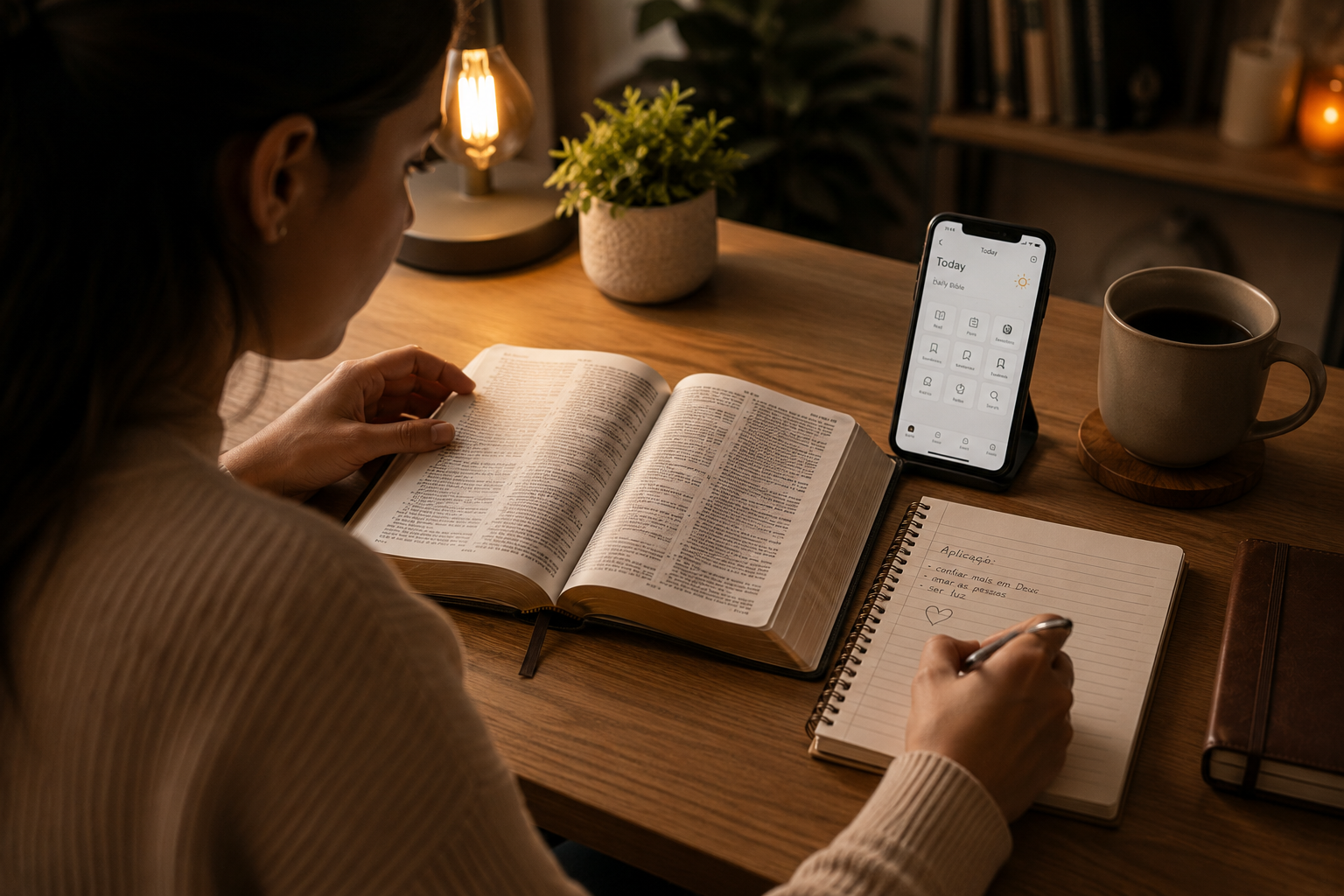
How to Build a Daily Bible Reading Habit
Most people quit Bible reading plans in early February. The problem is not willpower. It is design. Here is what actually works.
Sometime in early February, most people who started a Bible reading plan on January 1 have already stopped. This is not a character failing. It is a design problem.
The plans most people choose are structured around completion rather than formation. Read the entire Bible in a year. Finish Genesis by day twelve. The implicit message is that the goal is the last page. When life interrupts and you fall behind, the plan becomes an accusation rather than a guide, and most people quietly set it down.
The question worth asking is not: how do you read more? It is: what kind of reading actually changes you?
Why People Stop
There are two common reasons people abandon daily Bible reading, and they are almost opposite problems.
The first is confusion. Large sections of the Bible are difficult to follow without context: the genealogies of Chronicles, the legal codes of Leviticus, the prophetic oracles addressed to specific political situations long past. Without some understanding of what you are reading and why it was written, the text becomes opaque. Readers who hit these passages without support often conclude that the Bible is not for them, which is the wrong conclusion drawn from a real experience.
The second reason is the absence of feeling. Many people begin Bible reading expecting each session to be emotionally significant. When the experience is ordinary, or dry, or simply quiet, they interpret the absence of feeling as absence of God, and gradually stop showing up. This is a mistake about what reading Scripture is. It is not primarily an emotional experience. It is a practice of attention. The feeling comes and goes. The practice is the point.
The Case for Small
The most effective daily Bible reading habit is almost certainly smaller than you think it should be. One chapter. One psalm. One passage from the lectionary. Five minutes of actual, present reading beats thirty minutes of distracted skimming by a large margin.
This is not about lowering the bar. It is about understanding how habits form. A practice you return to every day for a month does more for you than a practice you heroically attempt for two weeks before exhaustion sets in. The frequency is the formation. Not the quantity.
Start with something you can do on your worst day, the days when you are tired, late, overwhelmed, or simply not feeling it. If that is ten minutes before bed, that is the habit. Build from there if you want to, but build up from a foundation that already holds.
What to Read and When
The best time to read is whenever you will actually read. Morning works well for many people because the competing claims of the day have not yet arrived. But evening reading works too, as does a lunch break, or the minutes before your family wakes up. The question is not which slot is theoretically optimal. The question is which slot you will protect.
For what to read, a structured plan solves one specific problem: the daily decision of where to open. Decision fatigue is real, and having to choose a passage each day adds friction that compounds over time. A plan that carries you through a book, a theme, or the full arc of Scripture removes that friction. The best plan is one you will actually follow, which usually means one you find interesting rather than one that is most comprehensive.
Reading through a single book slowly, spending a week or more in one letter of Paul or one gospel, often yields more than racing through the full Bible in a year. Familiarity with a text is not a sign that you have exhausted it. It is a sign that you are beginning to read it.
When the Text Feels Dead
There will be mornings when you read a passage and nothing happens. The words land flat. You close the Bible and feel roughly the same as when you opened it. This is normal. It is not a sign that you are doing it wrong, that you lack faith, or that God is absent.
Thomas Merton wrote that the purpose of lectio divina is not to produce an experience but to dispose the soul toward one. The reading is the preparation, not the event. Some of the most transformative passages you will encounter are ones you read twenty times before they opened. The text was waiting. You needed to arrive.
On flat days, read anyway. Read slowly. Read aloud if that helps. Ask the simplest question: what is actually happening in this text? Who is speaking, to whom, about what? Let the surface question carry you until something underneath it shifts.
Missing Days
You will miss days. The goal is not a perfect streak. Perfect streaks are fragile, because one missed day ends them, and then the gap between you and the practice widens as guilt accumulates.
The goal is a direction. A practice you return to after three days away is still a practice. The only rule that matters is: when you miss, come back. Not with apology or elaborate re-commitment. Just open the Bible and read the next passage. The return is the habit.
Over months and years, the cumulative effect of ordinary, imperfect, inconsistent reading is not ordinary. You develop a familiarity with the text that changes how you read. Phrases surface at unexpected moments. Questions you did not know you were asking begin to find answers. The world described in Scripture and the world you actually inhabit start to overlap in ways that are difficult to explain and impossible to un-see.
That is what daily reading builds. Not information. Perception.
Start your journey today.
Free forever. No ads. Premium for AI only.
Available on
App Store