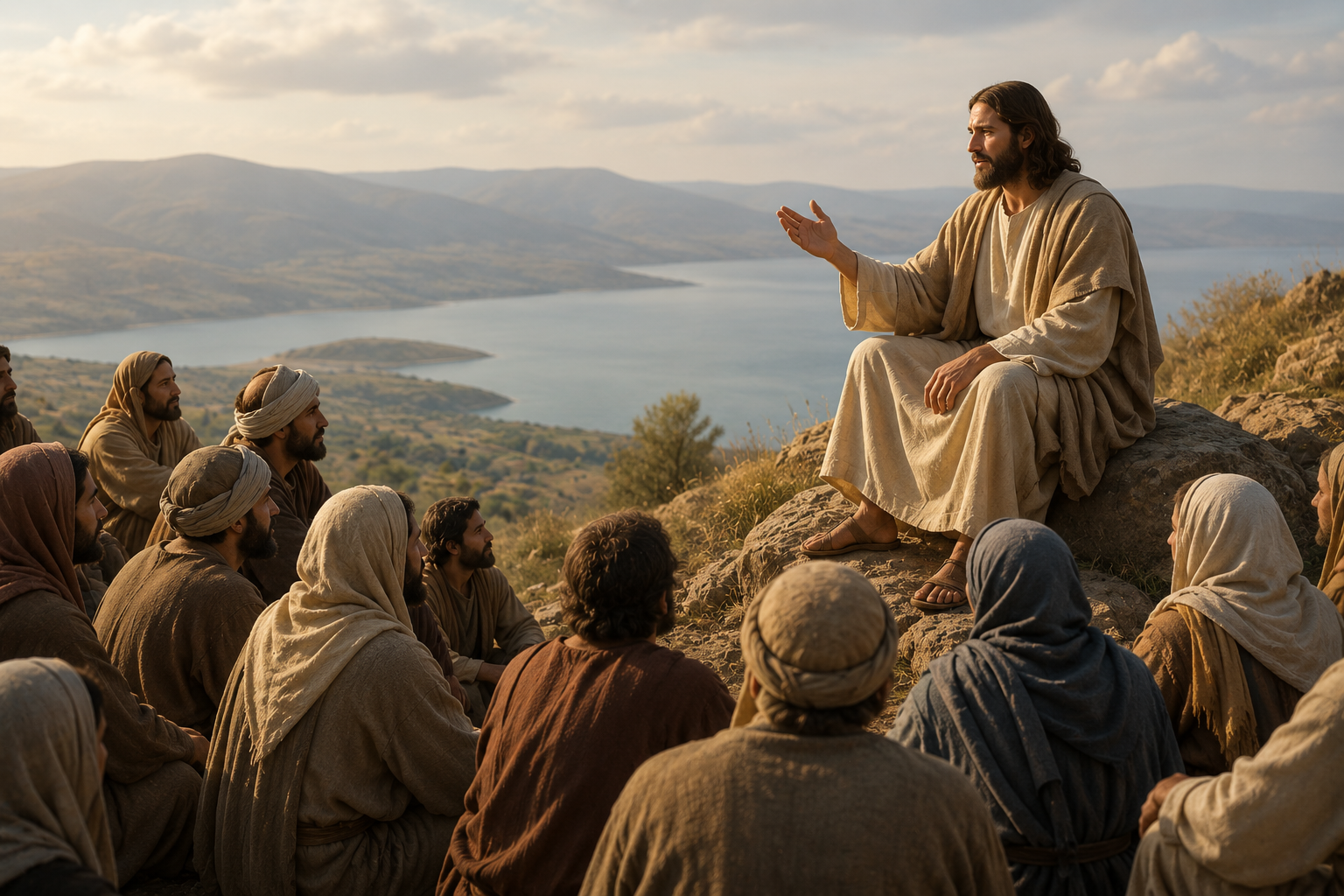
The Sermon on the Mount: Key Teachings Explained
The Beatitudes are not a to-do list. The Antitheses are not Jesus contradicting Moses. The Lord's Prayer is compressed theology. Reading Matthew 5-7 carefully changes what you thought you knew.
The first thing Jesus says in the Sermon on the Mount is not a command. It is an announcement.
"Blessed are the poor in spirit, for theirs is the kingdom of heaven." Not: become poor in spirit, and then you will deserve the kingdom. But: those who are already poor in spirit, the ones who know they have nothing to bring, those are the people the kingdom belongs to right now.
This distinction matters more than most readers realize. The Beatitudes are not a to-do list. They are not eight spiritual qualities you are supposed to cultivate. They are declarations about who already belongs to the kingdom of God, and the list is deliberately strange. The mourning. The meek. The persecuted. These are not the people who would appear on anyone's shortlist for divine favor. That is the point. Jesus is describing an inversion, not a reward system.
The Structure of a Mountain
Matthew places this sermon on a mountain deliberately. Jewish readers would have felt the echo immediately: Moses received the law on Sinai. Now Jesus ascends a hillside and begins to teach. The parallel is not accidental. Matthew is making an argument about who Jesus is before Jesus says a word.
What follows in Matthew 5 through 7 is the longest continuous teaching of Jesus recorded in any gospel. It is not a collection of independent sayings strung together. It is a sustained argument, moving from identity (the Beatitudes) to influence (salt and light) to the relationship between Jesus's teaching and the Jewish law (the Antitheses) to practice (prayer, fasting, giving) to anxiety and trust. Each section builds on the last.
You Have Heard It Said
The most theologically charged section of the sermon is the series of statements that begin: "You have heard that it was said... but I say to you."
Jesus takes six commandments and extends them inward. Do not murder becomes: do not harbor murderous anger toward your brother. Do not commit adultery becomes: do not entertain lust. Swear an oath honestly becomes: let your yes be yes, your no be no. In each case, the external command is not abolished. It is deepened until it touches something harder to manage than behavior: the interior life.
This pattern is not Jesus contradicting the Old Testament. He says explicitly at the beginning of this section that he has not come to abolish the law but to fulfill it. What he is doing is something more radical. He is claiming the authority to interpret Torah from the inside, to say what it was always aimed at. No rabbi in his tradition spoke this way. Rabbis cited precedent. Jesus cited himself.
A Complete Theology of Prayer
The Lord's Prayer in Matthew 6:9-13 is nine sentences. In those nine sentences, Jesus compresses a complete structure for approaching God.
It begins with address and worship: Our Father in heaven, hallowed be your name. Before any request is made, the posture is established. You are speaking to someone. He is holy. Those two facts shape everything that follows.
Then comes alignment: your kingdom come, your will be done on earth as in heaven. Not my kingdom. Not my agenda. The prayer orients the one praying toward a reality larger than their own situation. Then, and only then, come the requests: daily bread, forgiveness, protection. The sequence is theological. Worship precedes petition. Alignment precedes need.
Jesus's instruction before giving the prayer is worth noting: do not use meaningless repetition, piling up words in the hope that volume produces results. The prayer he offers is short and dense. The point is orientation, not performance.
On Worry
Matthew 6:25-34 is one of the most quoted passages in the sermon. It is also frequently misread as advice to be less anxious, as if anxiety were a character flaw to overcome through effort.
Jesus is not offering therapeutic advice. He is making a theological argument. Look at the birds. Look at the flowers. They do not work the systems of provision that human beings work, and yet they are sustained. The argument is not: stop worrying because everything will work out. The argument is: reorient your attention toward the One who sustains them, because your Father already knows what you need.
The famous line "seek first the kingdom of God and his righteousness, and all these things will be added to you" is the conclusion of that argument, not a separate principle. The remedy for anxiety in this passage is not self-discipline or better thinking. It is reorientation toward a Person.
The Final Test
The sermon ends with three contrasts: two gates, two trees, two houses. The narrow gate versus the wide one. The tree that bears good fruit versus the one that does not. The house built on rock versus the house built on sand.
In each case, the difference is not visible until a moment of pressure. The wide gate looks welcoming. The false prophet looks like a prophet. The sandy foundation looks like rock, until the rain comes and the flood rises and the wind beats against the house.
The sermon does not end with comfort. It ends with a question: what are you actually building on? The crowds who heard it that day were astonished, Matthew notes, because Jesus taught as one who had authority, not as their scribes. They recognized something had shifted. Whether they acted on it was another matter.
It still is.


Start your journey today.
Free forever. No ads. Premium for AI only.
Available on
App Store