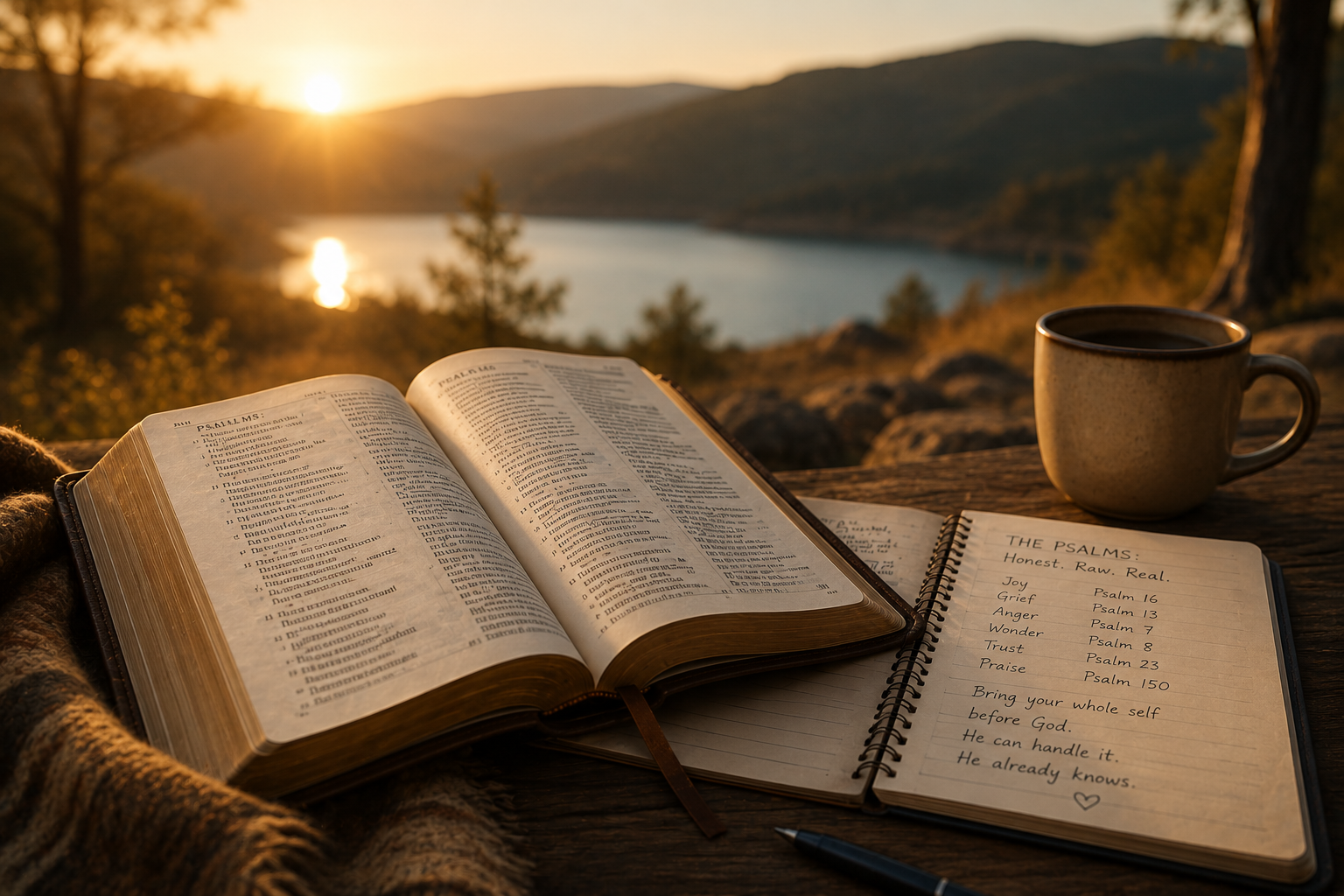
Understanding the Psalms: A Guide for Modern Readers
The Psalms are not devotional poetry for people with settled faith. They are records of actual people talking to God in rage, despair, confusion, and joy. They are permission.
Psalm 13 is six verses long. It opens like this:
How long, O Lord? Will you forget me forever? How long will you hide your face from me?
Psalm 13:1 — ESV
Most religious traditions tell you not to speak to God this way. The Psalms do not agree. The first two verses of Psalm 13 ask "How long?" four times in quick succession. It is not a polite inquiry. It is an accusation. And it is in the Bible.
This is the first thing worth understanding about the Psalms: they are not a collection of pious sentiments for people who have their spiritual lives in order. They are a record of actual human beings talking to God in every condition, including conditions of rage, despair, confusion, and abandonment. They are permission.
What the Psalms Actually Are
The 150 psalms were composed over a period of roughly a thousand years, from the time of Moses (Psalm 90 is attributed to him) through the exile and return. They were Israel's songbook, used in temple worship, in pilgrimage, in mourning, in celebration, and in private prayer. They were memorized, chanted, sung antiphonally, and recited at every major moment of the religious calendar.
Jesus quoted them from the cross. "My God, my God, why have you forsaken me?" is the opening of Psalm 22, and it is the last line attributed to Jesus in Mark's gospel. He was not composing a prayer in extremity. He was reaching for words that had been given to him, words that had already been prayed by every believer who had ever felt utterly alone.
That is what the Psalms are for.
The Structure of a Lament
Lament psalms are the largest single category in the Psalter, which says something about the nature of faith that most devotional literature ignores. The structure is remarkably consistent: address (God, I am speaking to you), complaint (here is what is wrong), request (do something), and then, in most cases, a turn toward trust or praise.
Many readers focus on the turn, as if the complaint were merely a preliminary to the praise. But the complaint is not incidental. It is the prayer. The movement from complaint to trust is not a shortcut to skip. It is the path. You cannot arrive at the trust without traveling through the complaint, and the Psalms seem to understand this better than most sermons do.
Psalm 13, after its four-fold "How long," ends: "But I have trusted in your steadfast love; my heart shall rejoice in your salvation." The resolution is real. But it arrives at verse five. Verses one and two are allowed to be what they are.
The Uncomfortable Psalms
Some psalms are harder to read than others. Psalm 137, the great lament of the Babylonian exile, ends with a verse that disturbs nearly every reader who reaches it: a blessing pronounced on whoever dashes Babylonian infants against the rocks.
These imprecatory psalms, psalms of violent cursing against enemies, have troubled Christian readers for centuries. Some traditions skip them entirely. That approach, however understandable, misses what they offer.
The psalms that express rage and desire for vengeance are prayers that acknowledge the full force of human hatred and put it before God rather than acting on it. The psalmist is not endorsing violence. He is praying his violence. He is bringing what is actually in him into the presence of God rather than pretending it is not there. This is more honest and, in a strange way, more reverent than the sanitized prayers that present God only with what we think he wants to hear.
Reading Psalms as Poetry
Hebrew poetry does not work the way English poetry does. It does not rhyme, and its meter, while present, does not translate well. What it does instead is repeat and develop ideas in parallel. A line makes a statement. The next line restates it, deepens it, or turns it. This pattern, called parallelism, means that Psalms reward slow, ruminative reading rather than fast linear progression.
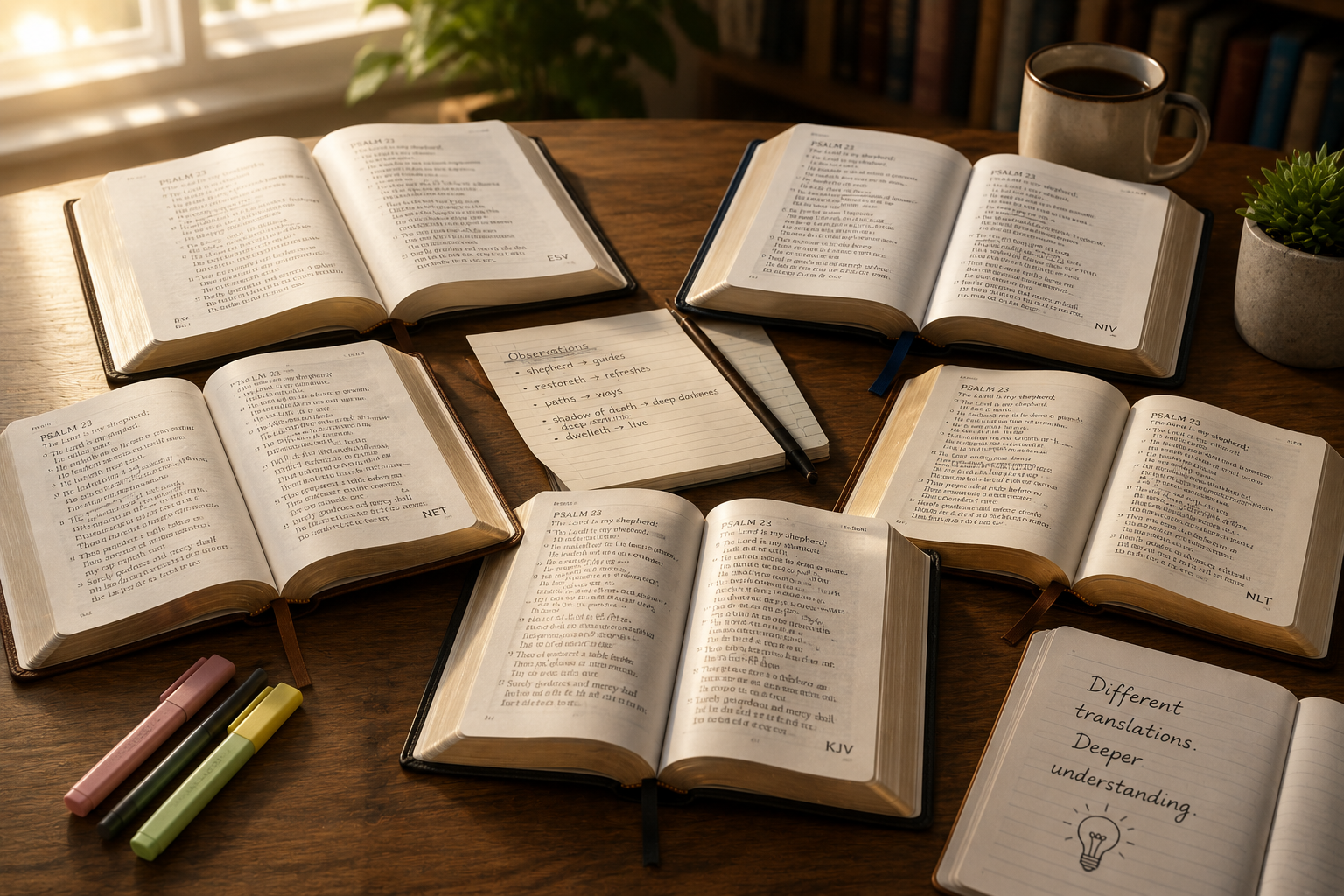
Consider Psalm 46:10: "Be still, and know that I am God." It is one of the most quoted verses in the Psalter. But the Hebrew word translated "be still" does not mean quiet contemplation. It means cease, stop, let go. The context is military. God is telling warring nations to drop their weapons. The verse is an announcement of sovereignty, not an invitation to meditation. Both readings are true, but knowing the first one changes how the second one lands.
A Map of the Psalter
The 150 psalms are arranged into five books, a structure that mirrors the five books of Moses. Book One (Psalms 1-41) opens with an introduction to the whole Psalter: Psalm 1, which sets up the contrast between the righteous and the wicked, and Psalm 2, a royal psalm about the anointed king. Most of Book One consists of David's personal prayers.
Books Two and Three (Psalms 42-89) expand toward community and national concern, including the great communal laments of the Korah psalms. Book Four (Psalms 90-106) responds to the crisis of the exile, asking how God reigns when the kingdom has collapsed. Book Five (Psalms 107-150) moves toward praise, culminating in the final five Hallelujah psalms that end with everything that has breath praising God.
The arc of the Psalter as a whole moves from instruction and lament toward praise. This is not an accident. The editors who arranged the psalms into this collection were making a theological argument: this is where honest prayer ends. Not immediately, not without the long road through lament and question and doubt, but eventually. In praise.
How to Actually Read Them
Read one psalm slowly. Not to extract information but to pray it. The tradition of lectio divina, reading sacred text slowly and allowing it to open, was built largely on the Psalms.
If you are in distress, look for a lament psalm. Do not skip to the resolution. Pray the complaint. Let the ancient words carry what you might not have words for yourself.
If you encounter a verse that disturbs you, sit with the disturbance. Ask what the psalmist was actually feeling, what historical situation might have produced this language, what it means to bring even violence and hatred honestly before God rather than pretending the impulse does not exist.
The Psalms have been prayed by every generation of Jewish and Christian believers for over two thousand years. They have survived every season of human experience because they were written in every season of human experience. Somewhere in those 150 poems, you will find yourself already there, already named, already given words for what you did not know how to say.
Start your journey today.
Free forever. No ads. Premium for AI only.
Available on
App Store